Fiscal epiphany for Ritter & Bennet?

Impending mortality tends to focus the mind, and looming elections tend to focus politicians' ears on vox populi. But just as theologians debate the sincerity of "deathbed conversions," voters should be skeptical of lawmakers who find religion as elections near. Although 15 months remain until the 2010 elections, Democrats are learning — just as Republicans discovered after their 2004 victory tour — how quickly the political winds can shift for the party in power.

In less than a year, Governor Bill Ritter has seen his favorable/unfavorable margin flip from plus-13 to minus-8, according to Public Policy Polling. Newly imposed vehicle licensing "fees," championed by Ritter, won't make Coloradans with cars or trucks any more charitable, either.

Ritter's beneficiary, appointed Senator Michael Bennet, hasn't impressed many outside his own party during his eight months in office. Bennet's approval/disapproval rating stands at minus-7 (34%-41%) among all voters, but even worse (minus-11) among unaffiliated voters.

Nationally, the trend is no more comforting for vulnerable Democrats: Rasmussen shows the generic congressional ballot favoring Republicans 43% to 38%, while Gallup says voters are souring on President Obama's health care push with 50% disapproving and 44% approving.

Not coincidentally, both Ritter and Bennet sought to induce a bit of voter amnesia recently with tough talk on taxing and spending.

Ritter told a gathering of municipal leaders that he won't ask for a tax hike in 2010. The AP report didn't mention whether Ritter's proclamation was met with audible laughter or just snickering.

Here's a governor who convinced the legislature and the state supreme court that legislation increasing property tax revenue isn't really a tax increase and therefore doesn't trigger the constitutional requirement for a public vote. As a result, property owners will pay some $200 million more this year than they would have without Ritter's "tax freeze."

In the wake of that ruling, Ritter and the Democrat legislature used a new loophole manufactured by the supreme court to enact an additional $125 million in tax increases — also without a vote of the people.

Just this year Ritter championed two new "fees" so large as to make taxes superfluous. First he enacted his famous vehicle fee to raise an estimated $250 million by increasing the cost of licensing almost every vehicle in the state by $41 to $51 annually. Then he signed a "hospital provider fee" that will, when fully implemented, raise $600 million a year from new charges on patient services.

With fees like that, who needs taxes?

Note that Ritter didn't vow to veto any tax increases sent to him by the legislature; he merely vowed not to ask for them.

Bennet's charade is pathetically weak, too, introducing the so-called Deficit Reduction Act of 2009 in an attempt to build credentials as a "fiscal hawk."

Remember that Bennet cut his senatorial teeth by voting for President Obama's $787 billion stimulus package — the one that stimulated very little and really costs $3.7 trillion, including $1 trillion in interest.

Bennet also helped kill a measure that simply sought to limit new federal debt over the next 10 years to no more than the old federal debt accumulated in the previous 220 years. That's right, the amendment would have allowed for a doubling of the federal debt but no more. Even that medicine was just too strong for Colorado's appointed junior senator.

Bennet's fiscal hawkishness is so feeble that he doesn't even bother to suggest that the federal budget should be balanced — only that overspending should be capped at 3% of GDP, not this year or next year or the year after that but by 2013. By that miserly standard, President Bush succeeded at least half the time.

No, Colorado's big spenders aren't changing their ways — just their words.

Mark Hillman served as Colorado senate majority leader and state treasurer. To read more or comment, go to www.MarkHillman.com.
Townhalls & Tea Parties

"The right of the people peaceably to assemble, and to petition the government for a redress of grievances," is constitutionally protected by the First Amendment. Thank goodness. The Tea Party rallies of this spring and the townhall backlash this summer on health care exemplify that sacred right in action, liberal slurs and conspiracy theories notwithstanding. The petition is not negated by strong words, nor the assembly by raised voices. Self-government in a free society is inherently raucous and messy. The stakes are too high for it to be otherwise. ** "Patient power" advocate Amy Menefee and Colorado Tea Party organizer Brian Campbell, now running for Congress, join me on Backbone Radio this Sunday.

** Plus Marvin Hutchens on national security issues and Amy Cook & Marty Neilson with a minority report from inside the state task force targeting TABOR.

** Plus homegrown Colorado novelists Allen Harris & Jason Gray on their fevered imagination about coffee shops, cancer cures, and college basketball.

And finally, while I seldom agree with Pelosi and Boxer, I've taken to heart their warning about this sudden rash of un-American, well-dressed protesters. From now on our show will entertain ill-dressed protest only.

Your voice of the rummage-sale right, JOHN ANDREWS

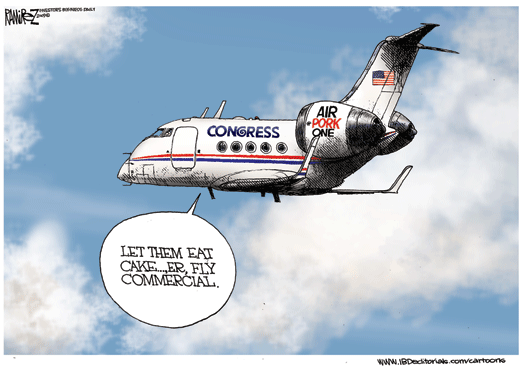
Let them eat...cake

I'm constantly amazed at the arrogance of our elected officials in Washington.  Service in the government was supposed to be a privilege, and members of Congress were supposed to be the people's representatives. Perhaps there was a time, before big money lobbying and ballooning budget deficits, when that was largely true. But not today.

Today we have a Congress made up of people -- on both sides of the aisle -- who think their position in Washington puts them above everyone else. They have created their own entitlement, with a prerogative that they can do as they wish, when they wish. They no longer work for us. We now work for them. Our tax dollars pay for their perks and their pork. And we are treated as if our opinions don't count. Its enough to make you realize that Reagan was right: Government is the problem.

toon081209

The evidence of this is everywhere -- from Congress wanting to spend $500 million on new jets for them to fly around the world (on our dime) to them refusing to use the same government-run health care that they are now trying to pass in the House. Last month, Republican Rep Dean Heller (NV) tried to put an amendment on H.R. 3200, the current House Health Reform legislation that would have required Congress to give up their rich health benefits and go on the government plan like everyone else.

Democrats also voted down an amendment from Rep. Dean Heller (R-Nv.) that would require all Members of Congress to get insurance through the government-run plan. Apparently Democrat members of Congress do not like the government plan they’re trying to inflict on the rest of us.

In a straight party line vote, Democrats voted against exempting themselves from the government-run plan by a vote of 21-18. “We also had an amendment to require that members of Congress must participate in the government-run plan,” Rep Dave Camp (R-Mich) said. “If it’s such a great idea, it should be a great idea for members of Congress. The majority voted to prevent that from happening. They voted to exempt members of Congress from the government-run plan.”

No surprise, of course, that Democrats rejected this amendment -- when you consider that progressive leadership in the House firmly believes it is superior to the common folk like you and me. They sit on high and decree, spending our money as if it is water and exempting themselves from their decisions. It is truly shameful.

Now there is another attempt at this, HR 615, sponsored by Rep John Flemming of Louisiana who is also a physician. Flemming has put a link on his website that has a petition -- you can go to it and sign here. The fate of Flemming's initiative, however, is already sealed: the scoundrels will never agree to being treated like "regular folk". They're special, remember?

Fortunately, history has its lessons, even if many choose to ignore them. Marie Antoinette also famously once said "let them eat cake". And we know what happened to her. She lost her head (literally) in the public square.

Cake, anyone?

Public assemblies, American style

The Obama Administration has been the occasion for numerous Tea Parties and Town Hall Meetings, which are different species of the genus public assembly.  How they are seen and understood depends a great deal on one’s point of view. As American government is based on the consent of the governed, it is perfectly appropriate and even necessary that public officials be chosen in periodic elections and that the people be free to express their views publicly. While the design of the Constitution is to avoid rule by the people in their collective capacity, relying rather on elected representatives, the First Amendment explicitly guarantees the right of the people to assemble peacefully for redress of grievances.

In our nation’s history, not a few of those public assemblies have been considerably less than peaceful, whether they were in opposition to taxes on whiskey, Jay’s treaty with Great Britain, the War of 1812, the Mexican War, abolition of slavery, the Civil War draft, industrial lockouts, World War I, racial segregation, the Vietnam War or the Iraq War.

Peaceful protest should always have the full protection of the law, and violent protests should be suppressed. The difficulty is that those rioting invariably see themselves as greater in authority than public officials, and the latter sometimes sympathize with the rioters’ goals, if not their means.

It is not surprising that the widespread Tea Parties that protested the record levels of taxing and spending by the Obama Administration should be viewed favorably by Republicans and unfavorably by Democrats. By the same token, the Town Hall Meetings called by the President and a number of Democratic Congresspersons and Senators are looked upon by Republicans as stage-managed affairs, lacking legitimacy.

So some Democrats supportive of Obama showed up to put a damper on the Tea Parties, and evidently more persons–of both parties–critical of the President, particularly his health care plan, have shown up at the Town Hall Meetings. Both parties clearly seek to establish their viewpoint as the authentic voice of the American people and the opposing view as merely a minority faction.

Although I welcomed the Tea Parties and look upon Democrat Town Hall Meetings with suspicion, I cannot say that I am pleased that more and more citizens are taking their grievances so noisily into public places and meeting halls. A major contributor to this development is the rise of Big Government, which treats opposition to its goals and methods as essentially illegitimate.

Fortunately, this year’s protests lack the violence that characterized the radical left’s opposition to the War in Vietnam, when both public officials and private citizens were targeted for bombs by the likes of the Weathermen, of which Obama friends Bill Ayers and Bernadette Dorn were members.

It is always a challenge for politicians to deal with tumultuous assemblies with a combination of good humor and firmness, granting the legality of the protest but seeking to defuse its passion and restore civil discourse. Politicians slandering citizens angry over the government’s less than candid explanation of its programs are pouring fuel on the fire.

This present situation is not unlike that of medieval Europe, ruled by monarchs and priests, in which ordinary people had no say and whose only form of protest was armed rebellion. It is only when citizens finally won the right to elect their leaders that the frequent resort to mob violence was no longer necessary.

But the longer that large, intrusive and costly bureaucratic structures dominate our lives, and render citizens powerless, the more those otherwise not inclined to angry outbursts will feel compelled to vent their spleen at the persons they chose to make their laws.

Far better, though, that we take advantage of constitutional structures that enable the people to vote for or against those persons they believe do–or do not–have the best interests of the nation at heart.

Democrats have long believed that, just as they have a monopoly on holding public office, they alone have reason to protest, even violently, if they feel strongly enough. Republicans more commonly look upon public office as a temporary calling and reluctantly take part in public protests.

And while leading Democrats have attributed base motives to Republican protestors (special interests, Ku Klux Klan members and even Nazis), the latter have not gone beyond labeling Democrats (accurately) as big taxers and spenders, socialists and petty tyrants.

We have an opportunity to restore government by the people in the 2010 Congressional elections and the 2012 Presidential election. That’s where the protests will really count.